
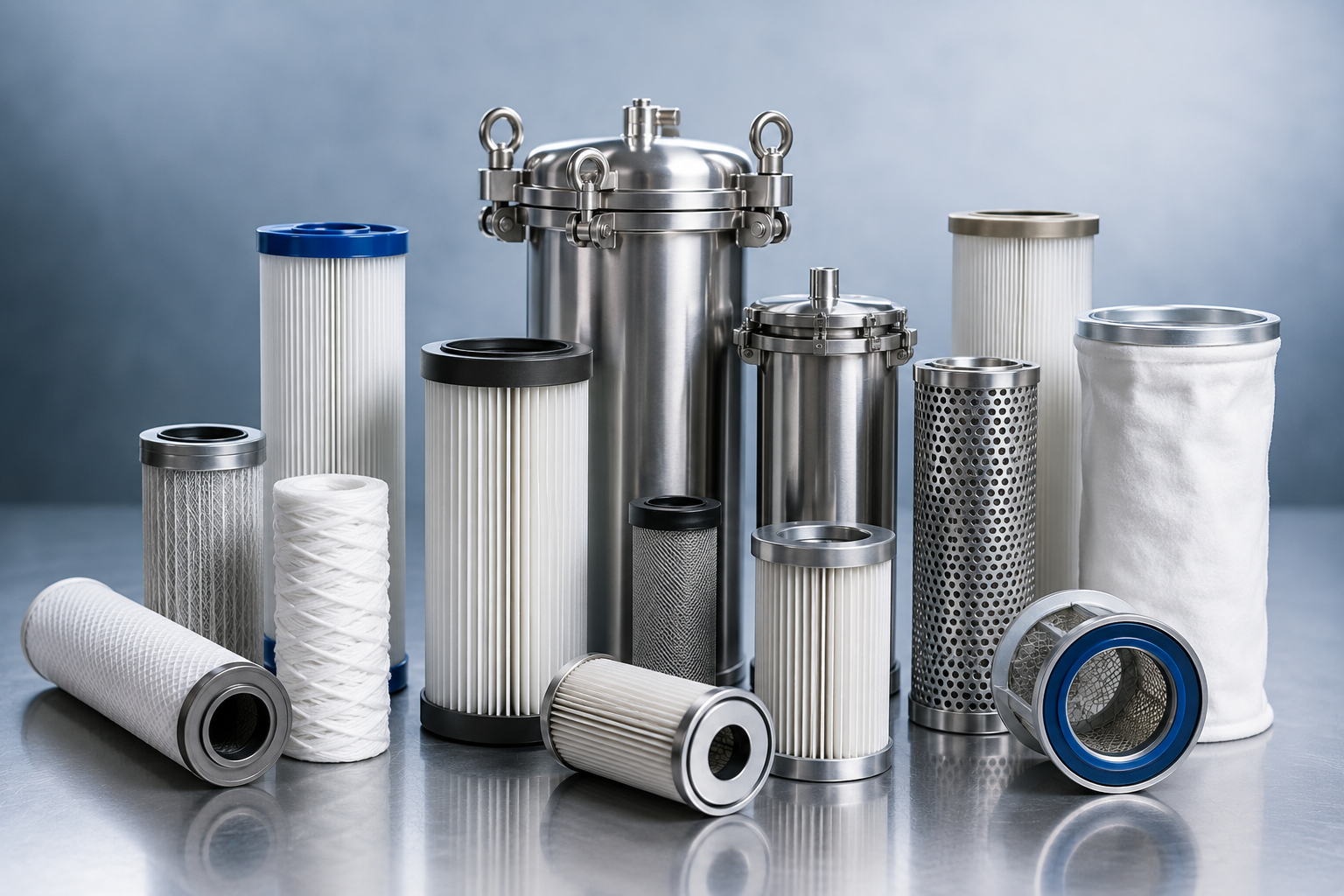
Industrial filtration is not just about choosing a micron rating. Good filtration design starts with understanding what needs to be removed, why it matters to the process, and how media, flow, pressure, and solids behavior interact in the real world.
This article introduces the core concepts behind process filtration, from Darcy’s Law and particle-removal mechanisms to surface versus depth filtration and the practical limits of micron ratings. The goal is to give engineers, operators, and buyers a more useful framework for selecting and optimizing filtration systems.
Why Filtration Exists in the First Place
Filtration is the controlled removal of contaminants from fluid streams. In industrial settings, that can mean removing suspended solids, protecting equipment, improving product clarity, achieving sterilization, or recovering valuable solids and liquids. The business case is often just as important as the technical one: better filtration can improve product quality, reduce downtime, protect downstream equipment, and lower total operating cost.
- Clarification and product polishing
- Equipment protection
- Sterilization or bioburden reduction in critical applications
- Liquid or solid recovery
- Energy and process efficiency improvements
- Product standardization and organoleptic control in food and beverage processes
Darcy’s Law: The Starting Point for Throughput
Darcy’s Law is a foundational way to think about filtration. It explains that flow through a porous medium increases with pressure and available surface area, and decreases with resistance, media thickness, and viscosity. In simple terms, more usable area and lower resistance generally allow more throughput at lower pressure drop.
The most practical takeaway is that many filtration problems are not solved by simply increasing pressure. In many cases, the real solution is reducing system resistance, by adjusting upstream conditions, selecting a more appropriate filter type, or using a filter aid where solids behavior makes straight filtration difficult.
What Influences Filtration Performance?
Filtration results depend on much more than the filter element itself. Performance is shaped by the contaminant, the fluid, and the process conditions around the filter:
- Contaminant size, shape, rigidity, and charge
- Fluid type and chemistry
- Flow rate and differential pressure
- Temperature and viscosity
- Batch size and solids loading
- Whether the filtration step is preventive, regulatory, or product-critical
The Main Mechanisms of Filtration
Industrial filtration works through several overlapping mechanisms. In liquids, direct interception is usually the dominant mechanism, but inertial effects, diffusional effects, and cake formation can all matter depending on the application and media
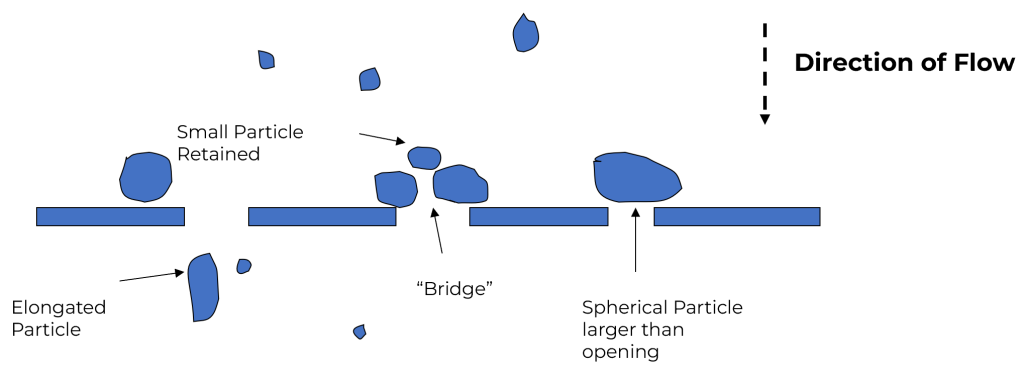
- Direct interception: particles are mechanically trapped as they attempt to pass through a restrictive path.
- Inertial impaction: particles leave the fluid streamlines and impact the media as flow changes direction.
- Diffusional interception: very small particles wander due to Brownian motion and are more likely to contact the media—especially in gas filtration.
- Bridging and cake formation: collected particles create a secondary filtration layer, increasing efficiency for fine particles over time.
Surface Filters vs. Depth Filters
One of the most important distinctions in filtration is whether the media captures particles mainly at the surface or throughout the depth of the structure.
Surface filters tend to have a more defined cut-off and are often used as final or polishing filters (i.e., filter cartridges). They can be pleated to provide high area and high flow, but usually have lower contaminant capacity.
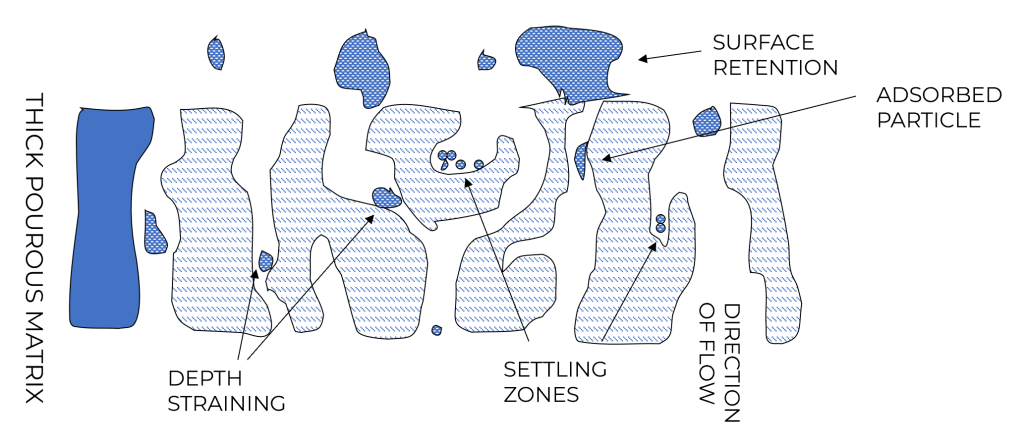
Depth filters, by contrast, retain solids throughout a thicker porous matrix (i.e., filter bags). They are often better suited to higher solids loading and are frequently used as prefilters to protect more expensive downstream stages.
Surface Filtration | Depth Filtration |
Defined cut-off particle size | Less defined cut-off but higher solids capacity |
Often used downstream as a final filter | Often used upstream as a prefilter |
High flow with pleated designs | Lower flow but higher dirt-holding capacity |
Best for cleaner streams | Best for turbid or heavily contaminated streams |
Surface Filtration
Depth Filtration
What a Micron Actually Means
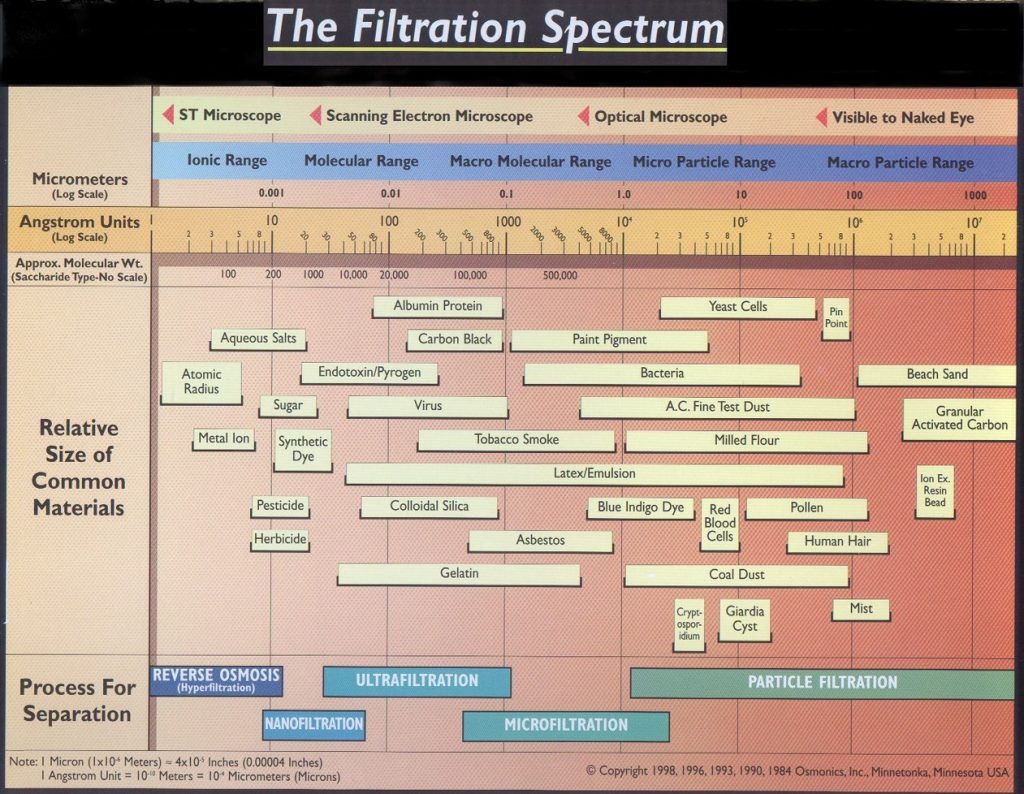
A micron is a unit of measure equal to one millionth of a meter. That definition is exact. What is not exact is the way a “micron rating” is used in the filtration market. Different products, media classes, and manufacturers may define and test ratings differently, which means the same nominal number can imply very different performance levels.
This is why filtration professionals should treat micron rating as shorthand—not as a complete performance description.
- 1 micron = 1/1,000,000 of a meter
- A human hair is roughly 70–100 microns
- The lower limit of human visibility is about 40 microns
- A micron rating is useful within a product line, but is often unreliable across different media classes or manufacturers
Nominal, Absolute, and Beta Ratio
Nominal ratings are generally based on a percentage removal at a given particle size, while “absolute” ratings are often presented as more stringent—but still depend on the specific test method used. Beta ratio is usually a much more useful performance metric because it directly ties upstream versus downstream particle counts to removal efficiency.
A practical rule of thumb is that beta 10 corresponds to 90% efficiency, beta 100 to 99%, beta 1000 to 99.9%, and so on. This is especially relevant when comparing prefilters, final filters, and membrane applications.
Why Upstream Filtration Matters
One of the strongest messages in filtration engineering is to get it right upstream. The final filter is usually the most expensive filter in the train. If upstream filtration is poorly designed, the final stage takes the punishment through premature differential pressure rise, short run lengths, and unstable performance.
Optimization often means reducing unnecessary stages, using more effective prefiltration, and matching surface area and media type to the actual solids challenge.
Conclusion
Filtration works best when it is treated as a system rather than a standalone product decision. Darcy’s Law, contaminant behavior, media structure, and efficiency testing all matter. By understanding these fundamentals, teams can make better design choices, reduce total cost, and protect the most critical parts of the process.
Need help turning filtration theory into a practical system recommendation? Contact Vytal to discuss your process goals, solids profile, and equipment constraints.